.png)
What Most People Get Wrong About DeFi and Real-World Assets
Most people think tokenization means putting assets on chain. It doesn’t. It means transferring money and ownership in the same click. Tokenization is about how capital moves. And today, it still moves on infrastructure built for a different century.
How Capital Moves (Slowly) Today
Information is instant. Value is not.
Even after the move to T+1 in U.S. equities, markets still run on a sequence:
Trade → Clear → Settle → Reconcile → Report
Each step takes time. Each step adds cost. Each step creates a window of risk.
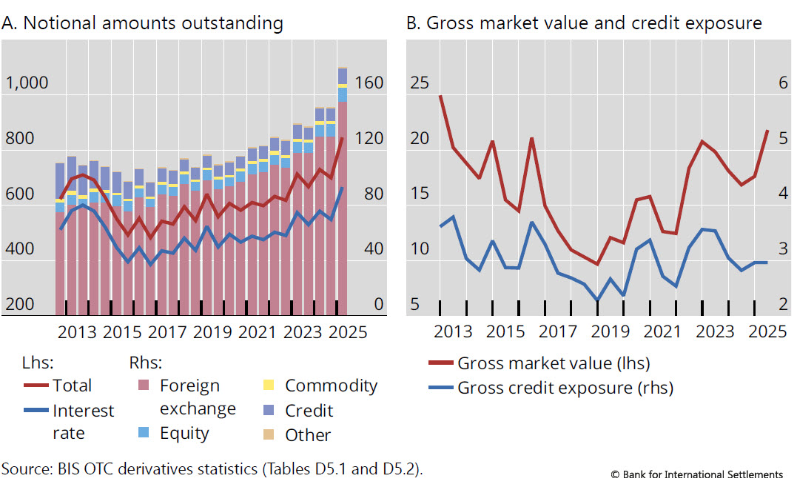
On a small scale, it’s trapped capital. At $600 trillion in derivatives and $130 trillion in bonds, it reflects systemic idle liquidity embedded in our global financial infrastructure.
The system works. It just runs on yesterday’s clock.
Outstanding OTC Derivatives
(Trillions in $ US Dollars)
The Real Change: Capital Velocity
Tokenization compresses time.
Think of it as capital velocity: the time between committing capital and being able to use it as collateral.
In legacy markets, that’s days or weeks. In programmable markets, it can be minutes. Not because the asset changed but because the workflow did.
Ending the Waiting Game
Today, ownership, cash movement, compliance checks, and ledger updates all happen separately.
Tokenization collapses them into one state change.
Cash moves. Ownership updates. Compliance is enforced. Records are written.
All at once.
And this isn’t hypothetical. BlackRock’s BUIDL, Franklin Templeton’s BENJI, and Ondo’s tokenized Treasuries are live. Stablecoins already settle hundreds of billions on-chain annually. The debate has moved from “if” to “which assets, which jurisdictions, how fast.
Atomic settlement is the breakthrough. Fractionalization is the marketing.
A Private Markets Reality Check
Take a private fund subscription.
Today:
- Capital call
- Wire sent
- Admin confirms
- Transfer agent updates the register
- Units issued days later
You’ve paid, but you don’t own it yet. Multiple ledgers need to agree. Reconciliation is a time-consuming process.
In a tokenized model:
- Eligibility checked in code
- Payment triggers unit issuance
- Cap table updates instantly
Delivery versus payment. One transaction. No reconciliation. Settlement, embedded.
The Stack Institutions Actually Care About
Most tokenization conversations focus on the token.
Institutions care about the stack:
- Legal enforceability
- Compliance at the transfer layer
- Atomic settlement
- Collateral mobility
Digitizing an asset is easy. Making it balance-sheet efficient is hard.
Balance Sheets, Not Blockchains
Institutions don’t adopt technology because it’s new.
They adopt when:
- It lowers operational cost
- It improves capital efficiency
- Regulators accept it
- Custody risk is controlled
That’s starting to happen.
Tokenized Treasuries are live. Stablecoins already settle hundreds of billions on-chain annually. Permissioned pools are being built for compliance-first liquidity.
The conversation has moved from “if” to “where it improves the balance sheet.”
What Changes in Market Structure
Tokenization doesn’t remove intermediaries. It reprices them.
Value moves from maintaining ledgers to controlling settlement.
Custodians who become key managers win. Collateral desks that can move assets in real time win.
What loses is any function whose value was the delay itself. Manual transfer agents. Reconciliation layers. Batch reporting cycles.
These were necessary given the infrastructure, but as the infrastructure changes, the old-world business cases disappear with it.
What Still Needs to Be Solved
The real work now sits in legal frameworks and operational execution.
The oracle problem is the deepest structural vulnerability in the stack. If the price feed linking real-world assets to on-chain state is stale or wrong, atomic settlement doesn’t protect you; it just executes the error faster.
An atomic settlement eliminates settlement risk. It doesn’t eliminate custodian failure, smart contract exploits, or issuer insolvency. The trust has been relocated, not removed.
On timeline, one variable matters more than any technology choice: regulatory clarity. MiCA, MAS, the FCA, and VARA are building different frameworks at different speeds. The first jurisdictions to resolve the legal status of tokenized ownership will capture volume.
That race is already underway.
.png)
.png)
.png)
.png)